For a first day in Seoul, keep your sightseeing in the historic center: visit Gyeongbokgung Palace in the morning, choose a short Bukchon walk if the visiting rules allow it, and continue through Insadong to Cheonggyecheon and Gwangjang Market. These Seoul tourist attractions fit together without crossing the city between every stop.
You will have time for a proper lunch and a tea break. Leave Hongdae, Gangnam and the river parks for another day; adding them here turns an afternoon of exploring into an afternoon of transfers.
Visitor information checked on 13 September 2026. All times are Korea Standard Time. The schedule and walking allowances below are planning estimates, with time for breaks, rather than measured walking times.
A manageable one-day route through central Seoul
Route: Gyeongbokgung → optional Bukchon → Insadong → Cheonggyecheon → Gwangjang Market. Plan for roughly eight hours, including meals. Skip Bukchon if you prefer less walking or are visiting on Sunday.
| Time | Plan | Moving on |
|---|---|---|
| 09:00–11:00 | Gyeongbokgung: main courtyards and the pond beside Gyeonghoeru | Allow 25–35 minutes to reach the Bukchon area, depending on your palace exit. |
| 11:30–12:15 | Optional short Bukchon walk; stay in permitted areas | Allow 15–25 minutes downhill toward Anguk and northern Insadong. |
| 12:30–14:30 | Lunch, craft shops and a tea break in Insadong | Walk south along Insadong-gil, then toward Jonggak and Cheonggyecheon; allow 15–25 minutes. |
| 15:00–16:00 | Follow an eastbound section of Cheonggyecheon toward Gwangjang Market | Leave the stream near the market and return to street level; allow another 10–15 minutes. |
| 16:15–17:15 | Early dinner or a few shared dishes at Gwangjang Market | Finish near Jongno 5-ga Station on Line 1. |
These are generous time windows, not appointments. A longer palace visit or a slow lunch is a good reason to shorten the stream walk. If you are tired after Insadong, use the subway from Jonggak to Jongno 5-ga instead and go straight to the market.
1. Start at Gyeongbokgung Palace
Give the palace the largest uninterrupted part of the day. Begin with the main courtyards and Geunjeongjeon, then walk toward Gyeonghoeru for a view across the pond. You do not need to reach every building to enjoy the contrast between the formal courtyards and the water.
Save Gyeongbokgung Palace (경복궁), 161 Sajik-ro, Jongno-gu in your map app. Aim to be at the visitor entrance around opening time rather than arriving at the subway station at 09:00. Allow extra time if you want to rent hanbok before entering.

Opening hours and last entry
| Months | Opening hours | Last admission |
|---|---|---|
| January–February and November–December | 09:00–17:00 | 16:00 |
| March–May and September–October | 09:00–18:00 | 17:00 |
| June–August | 09:00–18:30 | 17:30 |
Normally closed on Tuesdays. If the regular closing day falls on a public or substitute holiday, the palace normally opens and closes on the first non-holiday afterward. Check the notice for your exact date. These are ordinary daytime hours, not night-viewing hours. Official palace hours and closure rules.
Tickets, hanbok and visitor rules
Standard individual admission is KRW 3,000 for foreign visitors aged 19–64. Foreign visitors aged 18 or under and 65 or over qualify for free admission with proof of eligibility. Korean citizens have different age thresholds. Official admission fees and exemptions.
Hanbok wearers can qualify for free admission, including foreign visitors, but the outfit must meet the palace guidelines: a qualifying jeogori top together with a skirt or trousers. A hanbok skirt with an ordinary T-shirt does not qualify. Rent an outfit because you want to wear it, not simply to avoid a KRW 3,000 ticket. Official hanbok guidelines.
The grounds are smoke-free. Pets are not admitted, apart from qualifying assistance dogs. Picnic equipment and alcohol are restricted, and meals may only be eaten in designated areas. Respect barriers and staff instructions around historic buildings. Official visitor rules.
The guard-changing ceremony is scheduled for 10:00 and 14:00; the Korea Heritage Agency’s 10 August 2026 notice confirms its resumption after a heat-related suspension. Treat it as an optional addition and check notices shortly before visiting. If you want the morning ceremony, stay near the Gwanghwamun area first, then explore farther into the palace. Official ceremony update.
This route includes viewing Gyeonghoeru from outside. Entry into the pavilion is a separate special-visit arrangement, not something to assume a daytime ticket includes. Official 2026 Gyeonghoeru and Hyangwonjeong special-visit notice.
2. Make Bukchon an optional, respectful detour
Bukchon is a residential neighborhood, so a short walk is enough. Choose a permitted lane, look at the tiled roofs and timber details, and move on without gathering outside someone’s door. The slopes make this the first stop to cut if you have a stroller, use a wheelchair or want an easier day.
The red zone around Bukchon-ro 11-gil restricts tourist visits from 17:00 until 10:00 the next morning. Violations can incur a KRW 100,000 fine. This restriction applies to the designated zone, not every street around Anguk. Seoul also asks visitors to keep Sunday as an alleyway rest day; leave the residential lanes out of a Sunday itinerary.
Keep voices low, do not photograph inside homes, and avoid blocking entrances. Use the city’s official zone map and visitor notice to decide where to walk. Public streets do not require a village admission ticket; individual museums, workshops and experiences have their own arrangements.
3. Have lunch and slow down in Insadong
Walk back toward Anguk and enter Insadong from its northern end. This gives the day a useful pause: have lunch before browsing, then choose a few shops rather than inspecting every display. Ceramics, paper goods and small craft pieces are easier to compare when you are not rushing to another reservation.
Pick a restaurant with a visible menu and prices. Ask how many people a shared dish serves before ordering. For a later break, choose a tea house or café where you can sit down; the stream walk will be more enjoyable after a rest.
Insadong is a neighborhood rather than a single ticketed attraction. Shops, galleries and cafés set their own hours and closing days, so this itinerary places shopping in the early afternoon. Anguk Station Exit 6 is a useful landmark at the northern approach. Visit Seoul’s Insadong guide.
4. Walk a short section of Cheonggyecheon
From southern Insadong, head toward Jonggak and the stream. Continue east in the direction of Gwangjang Market. There is no need to walk all the way west to Cheonggye Plaza first unless you particularly want to see the starting point.
Choose a stretch that suits your energy. This part of the day is a walk beside the water, not a challenge to finish the whole stream. If you need step-free access, locate a ramp before descending; the nearest stairs may not have an adjacent accessible entrance.
The promenade is normally open around the clock, but rain can bring access restrictions. Do not enter a closed section or shelter below a bridge when access is being shut. Use the streets above instead, or go directly to the market. Official stream access information.
5. Finish with food at Gwangjang Market
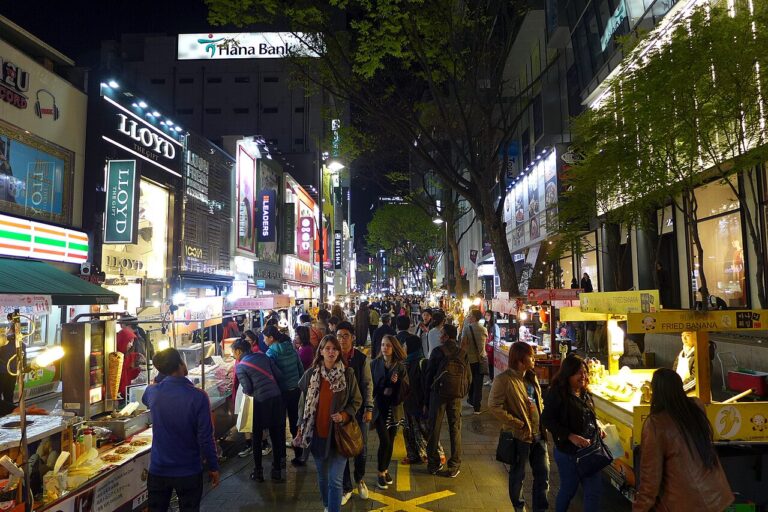
At the market, start by looking at a few menus before choosing a counter. Bindaetteok, a mung-bean pancake, works well as a shared first dish; small gimbap rolls make a lighter option. Order a little at a time, confirm the price and portion, and leave the aisle clear while deciding where to eat.

The Korea Tourism Organization lists general market hours of 09:00–18:00, with Sunday closure, but lists the food street separately as 09:00–23:00, open year-round. Individual vendors can keep shorter hours. A Sunday food visit is therefore different from a Sunday shopping visit, and arriving before the listed closing time does not guarantee a particular stall will still serve you. Official market hours.
Carry a little Korean cash and ask about card payment before ordering. For the journey back, Jongno 5-ga Station on Line 1 is nearby; Exit 8 is a useful market landmark. Seoul’s market location and access guide.
Adjust the day to your arrival time and the weather
- Only half a day: choose Gyeongbokgung and Insadong. Add the market only if you still have time and energy.
- Tuesday: move the palace visit to another open day. If Tuesday is your only day, start later around Insadong, then continue to the stream and market; check holiday exceptions before deciding.
- Sunday: skip Bukchon’s residential alleys. Use the extra time at the palace or over lunch, and remember the market’s food-street exception.
- Rain or extreme heat: shorten the outdoor sections and take a longer indoor break. Check palace and stream notices before setting out.
- Less walking: omit Bukchon and take the subway between Insadong’s southern end and the market. Check station elevator locations separately from the numbered exits in this guide.
A small bottle of water, comfortable shoes and enough phone battery for navigation are more useful here than a tightly packed checklist. Save the Korean place names before leaving your accommodation, and allow extra time wherever the route crosses a busy road.
Questions before your first Seoul sightseeing day
Which Seoul tourist attractions can I combine in one day?
Gyeongbokgung, Insadong, a short Cheonggyecheon walk and Gwangjang Market form a practical central route. Add Bukchon only if you are comfortable with the hills and can respect its visiting rules.
Can I visit Gyeongbokgung and Bukchon on the same morning?
Yes, on a suitable day. Start at the palace at 09:00 and reach Bukchon later in the morning, after the red zone opens to tourist visits at 10:00. Leave the residential lanes out on Sunday and check the palace’s Tuesday closure.
How much should I budget for admission?
For a foreign adult aged 19–64 paying the standard palace rate, allow KRW 3,000 for Gyeongbokgung. The route’s neighborhood streets, stream walk and market browsing do not require a general sightseeing ticket. Food, transport, shopping, hanbok rental and any optional paid venues are extra.
Can I add Hongdae or a Hangang picnic?
You can change the plan, but choose one evening priority. If Hongdae or the river is essential, finish the central route after lunch and allow time for the transfer. Do not treat a river picnic as a guaranteed final stop after a full day of walking.
Food, stays and local information
Links open in a new tab. Check current opening hours, availability and visitor notices before making plans.